European AI providers compared: how to choose
Four ways to buy AI in Europe, what each one costs and gives up, and the six questions that decide which fits your team. Including where we lose.
There are four ways to buy AI in Europe, not fifty, and comparing vendors before you have picked the category is how evaluations turn into three-month projects. The four are: an American chat subscription, an American frontier API, a European managed service on open-weight models, and self-hosting on your own European hardware. Each one wins on something and loses on something, and no option on the market today wins on everything.
This post compares the four honestly, including the rows where we come off worse. We sell the third one.
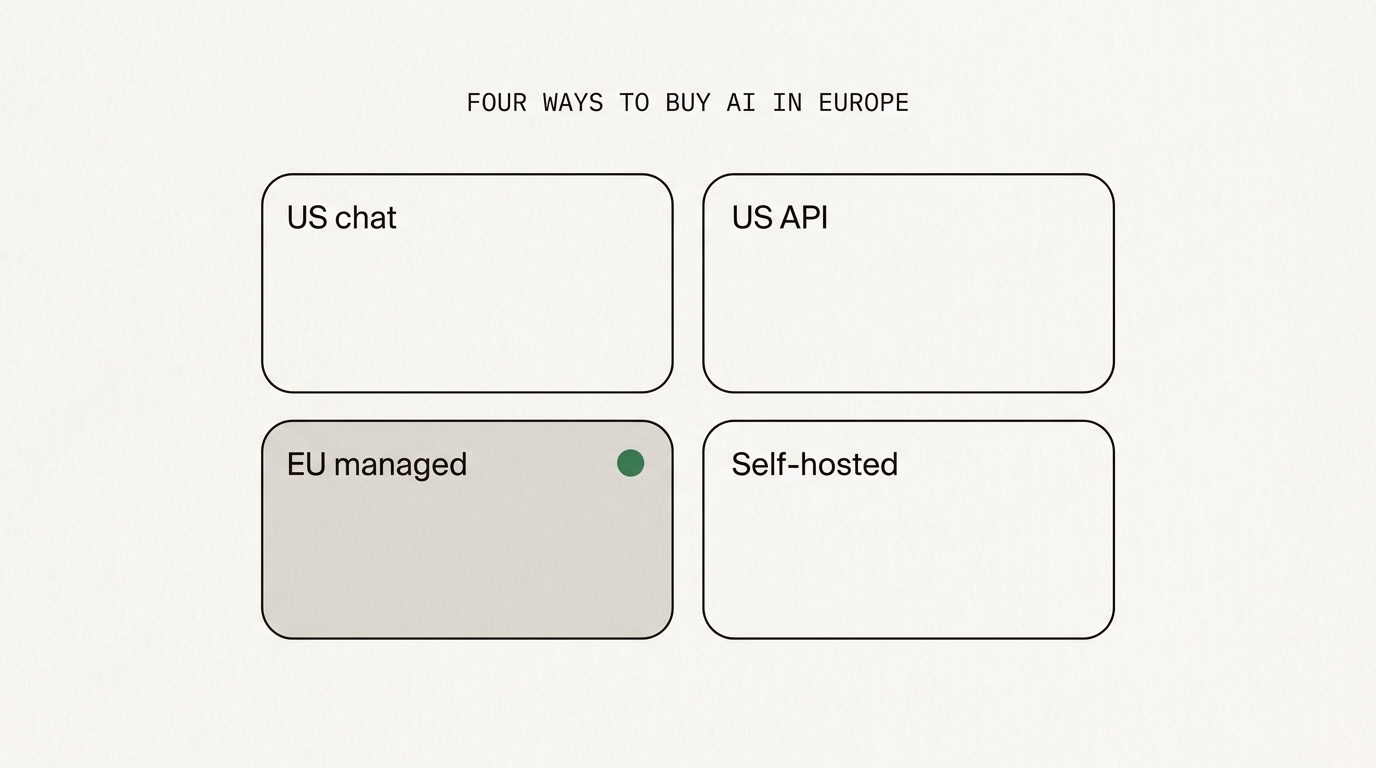
The four ways to buy AI in Europe
| Option | Strongest at | Weakest at |
|---|---|---|
| American chat subscription | Frontier capability, zero setup | Jurisdiction, price per seat, portability |
| American frontier API | Frontier capability, ecosystem | Jurisdiction, price per token |
| European managed open weights | Jurisdiction, price, portability | Frontier capability |
| Self-hosted on EU hardware | Control, unit cost at scale | Ops burden, fixed cost, model quality per euro |
The three European groups worth knowing about, inside that third row. European model labs such as Mistral and Aleph Alpha train their own weights. European clouds sell managed inference on open-weight models: OVHcloud AI Endpoints, Scaleway Generative APIs and the IONOS AI Model Hub all do this, mostly with OpenAI-compatible interfaces. And services like ours sit on top of that infrastructure with metering, routing, a chat product and support around it. Scaleway is our own inference provider, which is on the subprocessors page and is worth saying out loud in a post that names them as an alternative.
European managed open weights
1 of 1
Open-weight models served from the EU, per token or per seat.
Self-hosted on EU hardware
1 of 1
Your own GPUs or a rented cluster, your own stack around it.
American chat subscription
0 of 1
A seat per person, the strongest models, nothing to run.
Fails on: prompts stay in the eu.
American frontier API
0 of 1
The same models behind an API, priced per token.
Fails on: prompts stay in the eu.
Ask for everything at once and nothing scores full marks, which is the honest state of the market rather than a flaw in the table. Union AI is the third row, and it loses the frontier-capability line.
Six questions to compare any provider on
Vendor pages will not answer these in the same order or the same words. Asking them in this order makes providers comparable.
1. Where is inference processed?
Not where the company is registered, and not where the marketing page has a flag. The physical region where the model runs. Every serious provider answers this in one sentence, and the answer belongs in your own privacy notice, which is a good test of whether you actually got one.
2. Who is the operator, and under which law?
Region is not jurisdiction. A European region operated by a company with a United States parent brings the CLOUD Act with it, whatever the datacentre postcode says. Three parties in our own chain have a US parent, which is why we do not claim a sovereign stack. That distinction is worked through in where your prompts go.
3. Whose weights are these?
Open weight, closed weight, European-trained or not, and under which licence. Most European managed services run open-weight models trained elsewhere, ours included. That is a legitimate answer, and it is different from the answer a European lab gives, so know which one you are buying.
4. What does it actually cost per million tokens?
Input and output separately, at list prices, without batch or cache discounts on either side. Output dominates most real bills.
5. How fast could you leave?
An OpenAI-compatible API means the wire contract is portable and you are not rewriting an integration layer to switch. What is never portable is the prompt tuning and the evaluation set built around one model, which is the real switching cost. The mechanics are in switching in three lines.
6. What do they publish about themselves?
A complete subprocessor list with legal entities, a data processing agreement you can read before signing, retention periods per data type, and a plain statement about training on customer inputs. Providers that publish all four are rarer than they should be, and the ones that do are easier to defend to your own customers.
What the American incumbents cost, in euros
Real numbers, since a comparison without them is an opinion. These are standard list prices read on 20 August 2026, converted at €1 = $1.165, with no batch, cache or commitment discounts on either side, per million tokens, excluding VAT.
| Band | Union AI | OpenAI | Anthropic |
|---|---|---|---|
| Everyday work | €0.70 in, €3.50 out | €1.72 in, €10.30 out | €2.58 in, €12.88 out |
| Heavy reasoning | €4.00 in, €12.00 out | €4.29 in, €25.75 out | €4.29 in, €21.46 out |
| Cheap and fast | €0.40 in, €1.60 out | €0.17 in, €1.03 out | €0.86 in, €4.29 out |
Read the last row. On the cheapest band, OpenAI undercuts us, and a post that left that out would not be worth reading. Where open-weight serving wins is the middle and top: output tokens on the everyday tier cost about a third of the closest American equivalent, and the gap widens on heavy reasoning.
Chat subscriptions compare the same way. Ours is €13 a month excluding VAT, or €11 a month billed yearly, against roughly €19 for ChatGPT Plus and €17 for Claude Pro once both are put on the same VAT footing, so about a third less than the cheaper of the two. The live version of this table, with sources and footnotes for each rate, is on the pricing page, and what per-token pricing means in practice is in what an AI API costs per token.

Where European services still lose
Four honest weaknesses. If any of them is disqualifying for you, buy the American option and document the transfer analysis properly; that is a defensible decision.
- Frontier capability. The hardest reasoning, the longest agent chains and the most demanding coding work still go better on the top American models. Open-weight models have closed much of the gap for ordinary work and have not closed it at the top.
- Ecosystem gravity. Tutorials, integrations, framework defaults and hiring all assume the incumbents. Compatibility helps, but you will be the first person in your team to read a European provider's docs.
- Breadth of endpoints. Embeddings, image, speech and batch endpoints are patchy across European services. Ours does chat completions and says so.
- Redundancy. Several European services, ours included, depend on a single inference provider. Our fallbacks cover a failing model, not a failing provider, which is on the status page in those words.
Where they win
Jurisdiction, which is the whole reason this category exists: prompts processed in the European Union under a European operator, which makes your own documentation short and your customer conversations easy.
Price, on everything except the very cheapest band, because serving open weights costs less than serving frontier models.
Portability, because open-weight models and a compatible API mean the thing you depend on can be run by someone else, including by you.
Compliance work you do once, because a shorter transfer story makes the rest of the paperwork shorter too. What that paperwork actually involves, including a usage policy your team will follow, is in is ChatGPT GDPR compliant for company data.
Transparency, because a provider running published weights can tell you which model answered, under which licence, and reroute openly when a model ducks a legitimate question. Ours is documented on the AI transparency page down to the system prompt.
The question is not whether European AI can match the frontier. It is whether the frontier is what your workload actually needs, and for most workloads it is not.
How to run a two-week evaluation
Long enough to learn something, short enough that it finishes.
- Pick twenty real prompts from your actual traffic, including the three that always go wrong. Write down what a good answer looks like.
- Score two candidates blind. Same prompts, outputs stripped of vendor names, scored by whoever owns the feature.
- Price the same week of traffic on both, input and output separately.
- Send the six questions above to both providers by email and keep the answers. How fast and how plainly they answer is itself data.
- Run one real workload in parallel for a week, on a small share of traffic.
- Decide with a rollback plan. Keep the old provider configured for a fortnight after the switch.
Teams that follow this end up with a defensible decision either way. Teams that read comparison posts, including this one, and decide from the table alone tend to relitigate it three months later.
Where we fit, and who should not pick us
Union AI is the third row: open-weight models, all inference on infrastructure inside the European Union, a chat plan at €13 a month, or €11 a month billed yearly, and an OpenAI-compatible API priced per token from prepaid credit. We publish the model behind every tier, the complete subprocessor list including the parts with a US parent, and the fact that we have no throughput SLA.
Do not pick us if you need frontier reasoning at the very top of the market, if you need embeddings or speech endpoints today, or if you need contractual uptime guarantees for a critical system. Those are real requirements and we do not meet them yet. If what you need is ordinary work done well, in Europe, at a price you can predict, that exists now, and the first ten API requests cost nothing to test.
Frequently asked questions
What is the best European alternative to ChatGPT?
There is no single best one, because the answer changes with what you are buying for. If you want a chat assistant for a team, a European chat plan on open-weight models is the closest like-for-like swap. If you want an API, several European clouds now sell OpenAI-compatible inference on open-weight models, and the choice comes down to price, tier range and what each provider publishes about itself.
Which European AI providers are there?
Broadly three groups. European model labs such as Mistral and Aleph Alpha, which train their own weights; European clouds selling managed inference, including OVHcloud AI Endpoints, Scaleway Generative APIs and the IONOS AI Model Hub; and services like Union AI that run open-weight models on European infrastructure with their own metering, routing and support around them.
Is European AI as good as ChatGPT?
For most everyday work, close enough that the difference does not show. For the hardest reasoning, long agent chains and frontier coding, the American labs are still ahead, and pretending otherwise wastes your time. The practical test is your own twenty hardest prompts, not a leaderboard.
Can I run an American or Chinese model on European infrastructure?
Yes, if the weights are published under a permissive licence. Weights are a file, so where a model was trained and where it runs are separate questions. That is why an open-weight model from a US or Chinese lab can be served entirely from EU hardware, with your prompts never leaving that hardware.
How much cheaper is European AI?
On like-for-like tiers, often several times cheaper on output tokens, because open-weight models cost less to serve than frontier models. Not universally: the cheapest American models undercut the cheapest European tiers. Compare per million tokens, input and output separately, at list prices on both sides.
Does using a European provider guarantee GDPR compliance?
No. It removes the hardest transfer question and leaves the rest of your obligations untouched: a legal basis, a processing agreement, retention limits, access control and a policy people follow. A provider can only be compliant for its own half of the arrangement.
Should we self-host open-weight models instead?
Only if you have steady, high volume or a hard requirement that no third party touches the hardware. Self-hosting turns a per-token bill into a fixed GPU bill plus an ops burden, which pays off above a certain constant load and is expensive below it. Most teams reach that point later than they expect.