CLOUD Act and EU data: does EU hosting protect you?
The US CLOUD Act reaches data a US company controls, even on EU servers. What that means for your AI prompts, FISA 702 and Schrems II, and what helps.
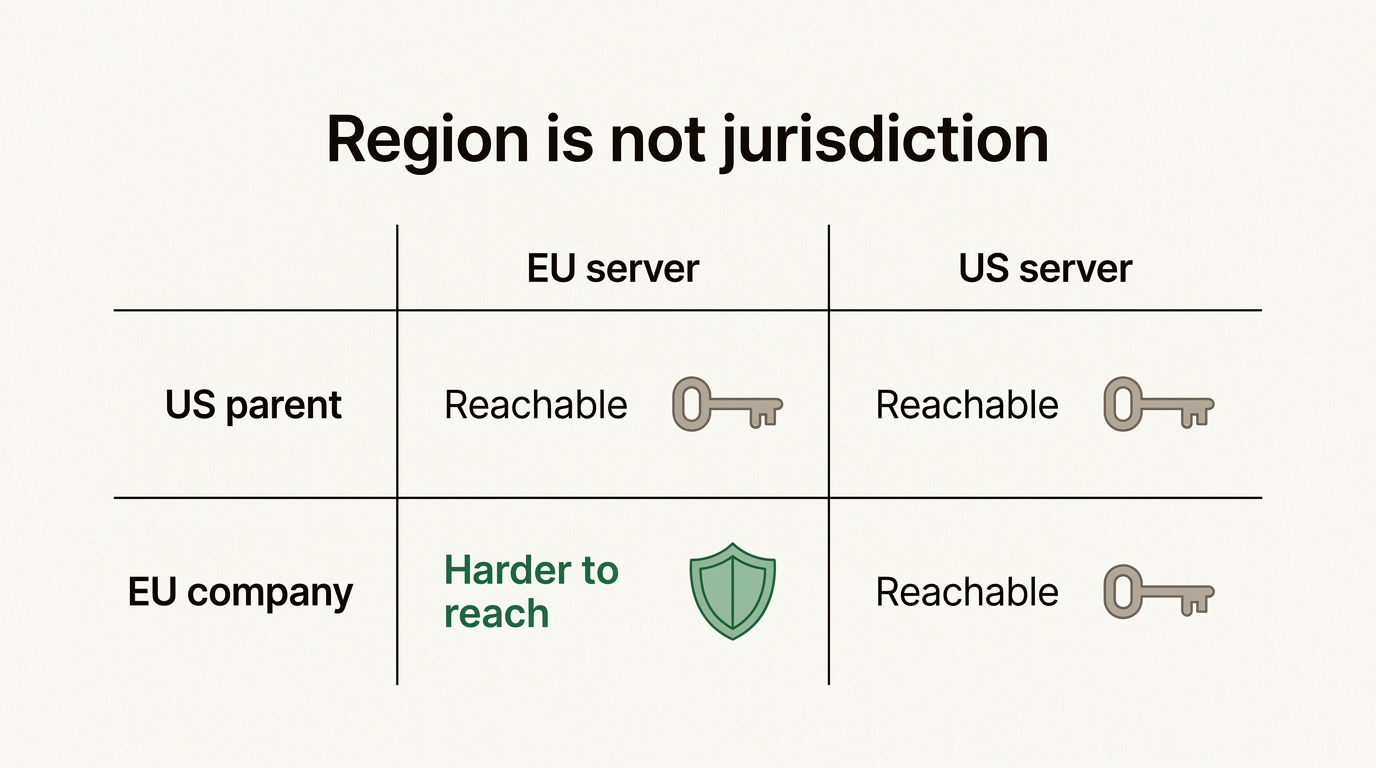
Yes, the US can reach data stored in the EU, if the company holding it falls under US jurisdiction. The CLOUD Act of 2018 obliges US providers to hand over data in their "possession, custody, or control", wherever in the world it is stored. So a US AI company's "EU region" changes where your prompts sit, not which government can order that company to produce them.
That does not mean anyone is reading your chats. It means "where is my data?" and "who can be forced to hand it over?" are two separate questions, and most marketing answers only the first. This post explains the second one: what the CLOUD Act and FISA Section 702 actually allow, what European courts have said about them, and what genuinely reduces your exposure when you use AI at work.
Can the US access data stored in the EU?
Yes, through the company, not through the building. US authorities do not raid a datacentre in Frankfurt. They serve a warrant or order on a US company, and that company is legally obliged to produce the data it controls, including data on servers abroad.
The rule sits in one short section of US law, 18 U.S.C. 2713, added by the CLOUD Act:
A provider "shall comply with the obligations of this chapter to preserve, backup, or disclose" communications and records "within such provider's possession, custody, or control, regardless of whether such communication, record, or other information is located within or outside of the United States."
Why the law was written
The CLOUD Act (Clarifying Lawful Overseas Use of Data Act) was a reaction to one case. In 2013 US prosecutors demanded emails that Microsoft stored in Dublin. Microsoft refused, arguing that a US warrant stopped at the US border, and won on appeal in 2016. The Supreme Court heard the case in February 2018. Before it could rule, Congress passed the CLOUD Act in March 2018, and the case was dropped as moot.
The US Department of Justice frames the Act as a clarification, not a new power. Its CLOUD Act resources page describes the problem it solves as evidence held by US-based global providers, "wherever it happens to be located". From a European point of view, that clarification is exactly the issue.
What "possession, custody, or control" means
Control is the word that does the work. If a US company can access or retrieve data, it controls that data, even if a European subsidiary technically operates the server. A US parent controls its Irish or German subsidiary. That is why an EU subsidiary of a US cloud provider does not escape the rule by being incorporated in Europe.
Does EU hosting protect you from the CLOUD Act?
No. EU hosting protects you from one thing: your data being stored and processed on hardware outside the EU. It does nothing about the nationality of the company that operates the hardware, and the CLOUD Act only cares about the second.
This is the difference between data residency (where the data sits) and jurisdiction (which state can compel the operator). The companion piece on EU AI data residency walks through residency hop by hop. The short version: they are separate dials, and big US providers now sell the first one hard.
- Microsoft completed its EU Data Boundary in February 2025, storing and processing core cloud data inside the EU and EFTA.
- OpenAI offers European data residency to eligible API, ChatGPT Enterprise and Edu customers.
Both are real improvements for residency. Neither changes jurisdiction. Microsoft said so itself. In a French Senate inquiry in June 2025, Microsoft France's director of public and legal affairs, Anton Carniaux, was asked to guarantee under oath that French citizens' data would never be passed to US authorities without French approval. His answer, as reported by The Register: "No, I cannot guarantee that". He added that it had never happened and that Microsoft challenges requests it considers unfounded. Both parts of that answer are worth taking seriously.
Pick where the data sits and who controls the provider below, and watch which of the two choices actually moves the answer.
Within US reach
EU region, US jurisdiction. The location is European; the company answering the order is not.
CLOUD Act warrant or orderReaches it
The provider must hand over what it controls, wherever it is stored. The EU datacentre does not change that.
FISA Section 702 directivePossible, contested
Directives go to US providers. How they are used for data held abroad is not public.
Mutual legal assistance via an EU statePossible, contested
Always available, but slower than going to the provider directly, so rarely the first choice.
A simplified reading of 18 U.S.C. 2713, FISA Section 702 and the usual treaty route. It leaves out intelligence collection that needs no company’s help at all, which neither dial changes much. Not legal advice: real cases turn on facts, contracts and the specific order.
The pattern is simple once you see it. Moving the data from a US to an EU datacentre changes very little when the owner is a US company. Changing the owner changes a lot.
What is FISA 702, and why does it matter more than the CLOUD Act?
The CLOUD Act is about criminal investigations: a warrant, a named account, a judge. FISA Section 702 is about foreign intelligence, and for Europeans it is the bigger issue.
Section 702 of the Foreign Intelligence Surveillance Act lets US intelligence agencies target non-US persons reasonably believed to be outside the United States, with the compelled help of US electronic communication service providers. There is no individual warrant per target. A secret court approves the overall programme once a year, and the agencies then send directives to providers. Cloud and AI companies can receive them, and a 2024 reform widened the definition of which providers qualify.
Every European is by definition a non-US person outside the US. That is the core of the problem.
What European courts said about it
In July 2020, in the case known as Schrems II, the Court of Justice of the EU invalidated the EU-US Privacy Shield. Its reasoning, in the Court's own press release on case C-311/18, was that US surveillance programmes based on Section 702 and Executive Order 12333 were not limited to what is strictly necessary, and that Europeans had no effective remedy against them. Standard contractual clauses survived, but only if the exporter checks the destination country's law and adds supplementary measures where needed.
The European Data Protection Board then published Recommendations 01/2020 on what those measures can be. Its main message for AI is uncomfortable: encryption works as a supplementary measure only when the importer never sees the data in the clear. A model that has to read your prompt always does.
Where 702 stands in 2026
Congress last renewed Section 702 in April 2024, with a sunset date of April 2026. It was extended twice for short periods and lapsed in June 2026 when the House and Senate failed to agree on reforms. That sounds like the end of it. It is not: collection continues under certifications the FISA court approved earlier in 2026, which run into 2027. For any risk assessment you write this year, treat 702 as in force.
Is a US AI company even allowed to hand over EU data?
Under EU law, not on the strength of a US order alone. Under US law, it must. That conflict is real, and the provider sits in the middle of it.
The GDPR is explicit. Article 48 says a court order or administrative decision from a third country requiring a controller or processor to disclose personal data can only be recognised if it is based on an international agreement, such as a mutual legal assistance treaty. A CLOUD Act warrant served directly on a company is not that.
The CLOUD Act has a way out, but a narrow one. A provider can ask a US court to quash an order when it would force a breach of a qualifying foreign government's law. A qualifying foreign government is one that has signed a CLOUD Act executive agreement with the US. The UK and Australia have one. The EU has been negotiating an e-evidence agreement with the US since 2023, and we could not find one in force as of September 2026. Without it, a provider can still argue general comity in court, but the statutory challenge does not apply.
| Legal instrument | Who uses it | What it reaches | Can EU hosting stop it? |
|---|---|---|---|
| CLOUD Act (18 U.S.C. 2713) | US law enforcement, with a warrant or order | Data a US-jurisdiction provider controls, anywhere | No |
| FISA Section 702 | US intelligence agencies, via directives | Communications of non-US persons abroad, with provider help | No, the directive goes to the company |
| Executive Order 12333 | US intelligence agencies | Signals intelligence collected outside the US | Not really, it needs no company's cooperation |
| Mutual legal assistance treaty | US authorities via an EU member state | Data held in that member state | It is the route EU hosting leaves them |
| GDPR Article 48 | EU law | Limits recognition of foreign orders | It is a counterweight, not a shield |
What about the Data Privacy Framework?
The EU-US Data Privacy Framework replaced the Privacy Shield in July 2023. It rests on Executive Order 14086, which added proportionality language to US intelligence rules and set up a Data Protection Review Court for European complaints. The General Court of the EU dismissed a challenge to it brought by the French MP Philippe Latombe in September 2025. His appeal to the Court of Justice is pending as case C-703/25 P.
The framework makes transfers to certified US companies lawful under the GDPR. It does not switch off the CLOUD Act or Section 702. Those two things are often blurred, including by vendors. A DPF certification answers "may I send personal data to this company?", not "can the US government get it from them?".
How big is the risk for your AI prompts?
Smaller than the headlines, bigger than zero, and different from ordinary cloud storage.
Smaller, because CLOUD Act requests target specific accounts in specific investigations. Asked about French citizens' data, Microsoft France told the Senate that a handover without French approval had never happened. For an ordinary company writing marketing copy, the realistic odds of a US order touching its chat history are low.
Bigger than zero, because the exposure comes from the legal structure, not from luck. Section 702 is designed for foreigners, runs without individual warrants and comes with secrecy. You cannot see it happen, so you cannot rule it out.
Different, because AI prompts are unusually rich. People paste whole contracts, customer emails, HR cases and source code into a chatbot, because that is what makes it useful. A chat history is often a better summary of a company's confidential work than its file server. If you want the decision tree for whether that is even allowed, read can you put customer data into an AI chatbot.
Where it matters most:
- Professional secrecy: lawyers, doctors, accountants and notaries, where disclosure to anyone is the breach.
- Health and special category data under Article 9 of the GDPR.
- Public sector work, where procurement rules increasingly ask about foreign jurisdiction.
- Trade secrets and anything under NDA with a customer who will ask where it went.
For everyone else, it is a line in your risk register and a question for your customers' security questionnaires, not a reason to ban AI. The post on whether ChatGPT is GDPR compliant covers the compliance side in more depth.

What actually reduces your exposure?
No single setting makes you CLOUD Act proof. A handful of choices reduce how much a foreign order could produce, and they stack.
1. Fewer US-controlled parties that see your content
Count the companies in the path that see the text of your prompts, and check each one's parent. Every US-controlled party that sees content is one possible recipient of an order. Parties that only see account data or payment data are a smaller problem than the one running the model.
2. Keep content and identity apart
An order is more useful when one company has both who you are and what you wrote. A setup where the inference provider sees prompts but not your identity, and the billing provider sees your identity but not your prompts, limits what any single order can produce.
3. Short retention
Data that no longer exists cannot be produced. Ask how long prompts, outputs and chat history are kept, and whether you can delete history yourself. Zero retention for API traffic is the strongest version.
4. Encryption where it genuinely works
Encrypt files at rest with keys you hold, where you can. Be honest that it does not cover inference: the model reads plaintext.
5. Contracts and a transfer impact assessment
Your data processing agreement should say what the provider does with a government request: challenge it, redirect it to you, tell you unless legally barred. If personal data goes to a US-controlled party, document a transfer impact assessment along the lines of the EDPB recommendations. The guide to a GDPR-compliant AI chatbot lists what to look for in a DPA.
Where does Union AI stand on the CLOUD Act?
Partly out of reach, and not fully. We would rather tell you which part.
All AI inference, meaning every prompt and every generated response, runs on infrastructure inside the European Union, operated by Scaleway, a French company. The models run under our management and are not trained on customer data. That covers the layer that matters most for this post: the company running the model is not a US company.
Three parties in our chain do have a US parent, and our subprocessor list names all of them:
- Cloudflare hosts the site and terminates TLS at its edge, so request content passes through the memory of that edge.
- Neon runs our database in an EU region on AWS.
- Stripe handles payments, through its Irish entity.
So we do not call Union AI "CLOUD Act-free" or a "fully sovereign stack". Both would be false. We explain the layers in European sovereign AI, and business customers get the same list contractually in our data processing agreement.
If you are weighing a move away from a US assistant, the European alternatives to Claude, Copilot and Gemini compares the options, and switching your team from ChatGPT covers the practical steps. Our chat is one plan at €13 a month excluding VAT, or €11 a month billed yearly, and the API is paid per token from prepaid credit; both are on the pricing page.
The honest summary for any provider, including us: ask where the model runs, who owns the company running it, and who else in the chain sees your text. A provider that answers all three in writing is telling you more than one that answers only the first.
Frequently asked questions
Does the CLOUD Act apply to European companies?
It applies to providers subject to US jurisdiction. A European company that is a subsidiary of a US parent is caught, because the parent controls its data. A European company with its own offices, staff or servers in the US may be caught too, depending on how a US court weighs those contacts. A European company with no US presence at all is not a realistic target for a CLOUD Act order.
Is Microsoft's EU Data Boundary or OpenAI's EU data residency enough to avoid US access?
No. Both are data residency features: they control where data is stored and processed. They do not change the fact that the provider is a US company, which is what the CLOUD Act turns on. Microsoft France told a French Senate inquiry in June 2025 that it could not guarantee, under oath, that data would never be handed to US authorities without French approval.
Will I be told if US authorities request my data from a provider?
Not necessarily. A US court can order a provider not to notify the customer for a period, under 18 U.S.C. 2705(b). Many large providers commit to redirecting requests to the customer and notifying them where the law allows it, but that promise has an explicit exception for gag orders. Read the government access section of your provider's data processing agreement to see what they actually commit to.
Does encryption protect my data from the CLOUD Act?
It helps when you hold the keys and the provider cannot decrypt, because a provider cannot produce plaintext it does not have. For an AI chatbot or API that protection mostly disappears, since the model has to read your prompt in plaintext to answer it. Encryption at rest with provider-managed keys does not help at all against an order served on that provider.
Is the EU-US Data Privacy Framework still valid in 2026?
Yes, as of September 2026. The General Court of the EU rejected a challenge by the French MP Philippe Latombe on 3 September 2025, and his appeal to the Court of Justice is pending as case C-703/25 P. The framework governs transfers of personal data to certified US companies; it does not stop the CLOUD Act or FISA from applying to them.
Did FISA Section 702 expire in 2026?
The statute was due to sunset in April 2026, was extended twice for short periods, and lapsed in June 2026 when Congress did not agree on a renewal. Collection continues under certifications the FISA court approved earlier in 2026, which run into 2027. For planning purposes, treat Section 702 as still in force.
Is it illegal to use an American AI chatbot in the EU because of the CLOUD Act?
No. Using a US provider is legal and common, including for personal data, as long as you have a lawful basis, a data processing agreement and a valid transfer mechanism. The CLOUD Act is a risk you document and weigh, not a ban. It matters most for professional secrecy, health data, trade secrets and public sector work.