Safe European AI chatbot, hosted in the EU
A safe German, Dutch or French AI chatbot is a European one: inference inside the EU, the GDPR, answers in your language. €13 a month, 5 free messages.
A European AI chatbot is a chatbot whose model runs on servers inside the European Union, under the GDPR, and answers you in your own language. That is the whole definition, and it is the same definition whether you searched for a German AI chatbot, a Dutch one or a French one, because inside the EU the law on your data is the same in all 27 member states. Union AI is one such chatbot: open-weight models, every inference executed inside the EU, €13 a month or €11 billed yearly, and the first 5 messages free.
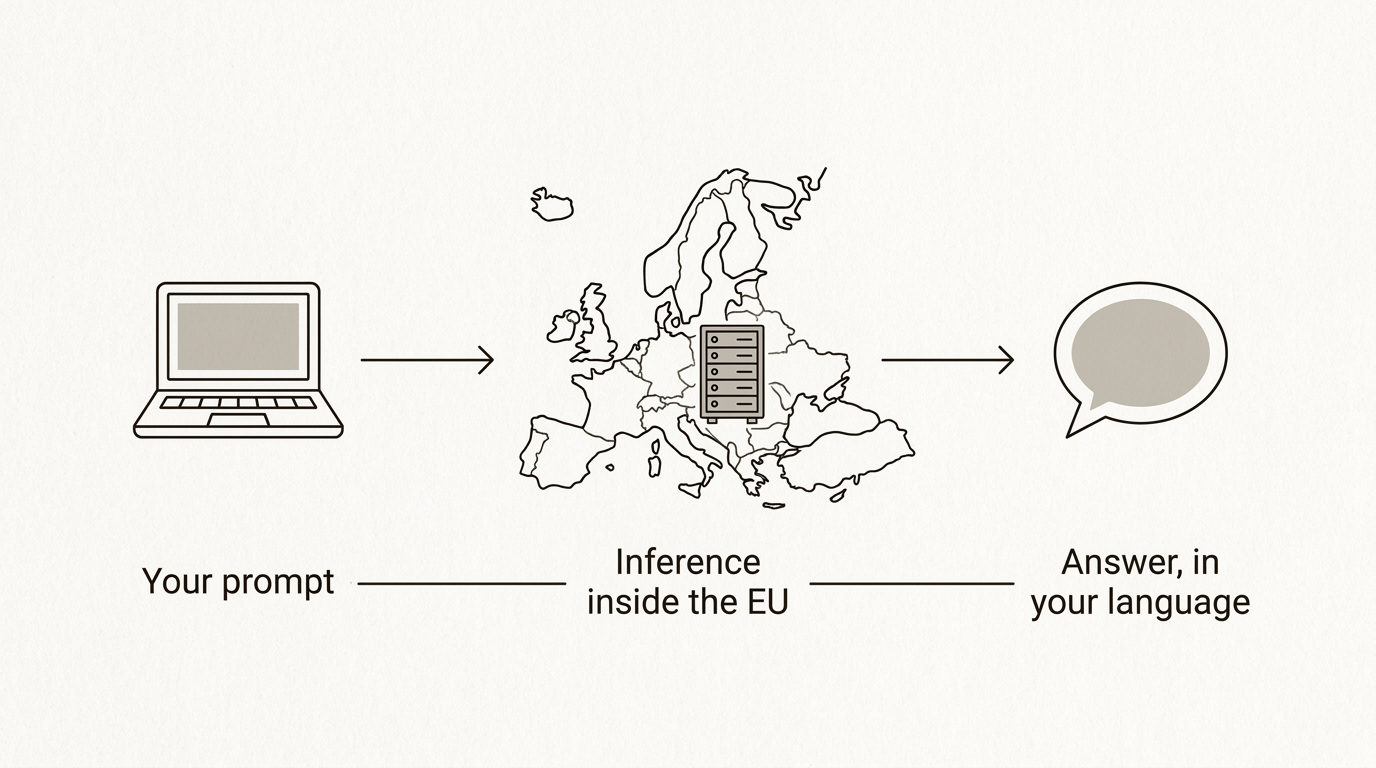
What makes an AI chatbot European?
Three things, and the order matters.
Where inference runs. Inference is the moment the model reads your prompt and writes the answer. Whichever machine does that has your prompt in memory, in plain text. If that machine stands inside the EU, your prompt is processed inside the EU. If it stands in Virginia, it is not, whatever the vendor's page says about "EU data centres" for storage. Storage and inference are different rows on a subprocessor list, and inference is the row to read.
Who operates it, and under which law. A datacentre inside the EU run by a company with a US parent is still reachable by US law. The CLOUD Act lets US authorities compel a US company to hand over data it controls, wherever that data is stored. Region and jurisdiction are two different questions, and a chatbot that only answers the first is answering the easy one.
Whose weights these are. An open-weight model is a model whose trained parameters are published, so anyone with the hardware can run it. That is what lets a European operator run the model on European hardware without sending your prompt to the company that trained it. A closed model, like GPT, Claude or Gemini, can only run where its owner runs it.
We walk through the full four layers of this in what European sovereign AI means in practice. For a chatbot, the first two are what you can check, and the third is what makes the first two possible.
Is there a German AI chatbot? A Dutch one? A French one?
Yes, and it is mostly the same product. People search for "German AI chatbot" or "safe Dutch AI chatbot" because they want three things: answers in their language, their data under their own country's rules, and no quiet trip across the Atlantic. Two of those three do not stop at the national border.
What "German AI chatbot" is really asking for
Take the German case. A German user pasting a contract into a chatbot wants German answers and wants German data protection law to apply. Both happen with any chatbot processing inside the EU, in whatever member state. The GDPR is a regulation, not a directive: it applies directly and identically in Germany, the Netherlands, France and the other 24 member states. Moving personal data from Munich to a server in another EU country is not an international transfer at all. Chapter V of the GDPR, the part about transfers, is about third countries, and an EU member state is not one.
So "German" and "European" describe the same legal position. What a German server would add is national pride, and a slightly shorter cable.
What does differ per country
Three things are genuinely national. Your supervisory authority is national: the BfDI and sixteen state authorities in Germany, the Autoriteit Persoonsgegevens in the Netherlands, the CNIL in France. Each country has a national act that fills in the choices the GDPR left open, such as the age of digital consent or rules for employee data. And the language itself: a model that is fluent in English and passable in Polish is not a Polish chatbot, whatever server it runs on.
Pick your country below and see which of these change, and which do not.
Changes with Germany
- Your regulator
- BfDI, plus one authority per federal state
- National act alongside the GDPR
- Bundesdatenschutzgesetz (BDSG)
- Language you write in, and get back
- German
Same in every member state
- Law on your prompts
- The GDPR, Regulation (EU) 2016/679, identical in all 27 member states
- Transfer status
- Not an international transfer. Chapter V of the GDPR is about third countries, and another member state is not one
- Where Union AI runs inference
- Inside the European Union, on any tier
The left column is what a German chatbot adds: a regulator to complain to and a language to think in. The right column is the part people are actually worried about, and it does not move. Regulator and act names are public facts; none of this is legal advice.
Why the language question is the one to test
Union AI's published system prompt instructs the model to answer in the language you write in. The open-weight models we run were trained on multilingual data and handle German, Dutch, French, Spanish, Italian and Polish well in our own use. "Well" is not "flawless": long legal German and idiomatic Dutch are harder than a product description. Test it with your own texts before you decide, and use the first 5 free messages for exactly that.
Why does it matter where a chatbot's servers are?
Because your prompts are the most sensitive text you produce all day. A customer complaint, a draft appraisal, a contract clause, a medical question you would not ask a colleague. Where that text is processed decides three things: which law protects it, who can be compelled to hand it over, and whether it ends up inside the next version of a model.
Region is not jurisdiction. A prompt processed in an EU datacentre owned by a US company is inside the EU and inside the reach of US law at the same time.
The training question is the one most people underestimate. Consumer chatbots from US providers may use your conversations to improve their models, depending on the account tier and the settings you have chosen. Business tiers generally do not. Union AI does not on any tier: the models run under our management and are not trained on customer data, which is stated on our subprocessors page and, for business customers, in the data processing agreement.
The European Data Protection Board took a position on training in December 2024. In Opinion 28/2024 it stated that AI models trained on personal data cannot automatically be considered anonymous, and that a provider relying on legitimate interest to train on your data has to pass a three-step test of interest, necessity and balancing. The simplest way to pass that test is not to train on customer conversations at all.
| US consumer chatbot | Union AI | |
|---|---|---|
| Inference | Region chosen by the vendor, typically the US | Inside the European Union |
| Parent entity of the operator | United States | European |
| Trained on your prompts | Depends on tier and settings; check before pasting | Never, on any tier |
| Law that reaches your prompts | GDPR, plus US law via the parent entity | GDPR |
| Models | Closed, named by brand | Open weight, named per tier with licence |
| Price | From about €20 a month | €13 a month excluding VAT (€11 billed yearly) |
Is a European AI chatbot as good as ChatGPT?
For most everyday work, yes. For the hardest reasoning tasks, the closed frontier models from the US are still ahead, and pretending otherwise would be the kind of overclaim this site exists to avoid.
Union AI runs four tiers of open-weight models, and the chat plan includes all of them. Lite (gpt-oss-120b) for quick questions, Standard (Qwen 3.6) as the default workhorse, Long context (DeepSeek V4 Flash) for a whole case file or codebase in one prompt, with a context window of a million tokens, and Pro (GLM 5.2) for heavy reasoning and code. Which model sits behind which tier, and under which licence, is on the AI transparency page.
One honest caveat about open-weight models. Some of them were trained under legal systems with their own sensitivities and duck away from factual questions about politics or history. We treat that as a defect, not a value: if we detect such a refusal in the first sentence of an answer, we cancel it and rerun the question on a model without that blind spot, and you see a small label next to the answer when that happened. Genuine safety refusals are never rerouted.
For a side-by-side of the four ways to buy AI in Europe, including where we lose, read European AI providers compared.
How to check whether a chatbot is really European
Ten minutes, five steps. Any provider that fails step one has answered the question for you.
- Find the subprocessor list. If there is none, stop. A provider that cannot tell you who processes your data does not know, or does not want you to.
- Read the inference row, not the hosting row. "Hosted in the EU" often means the website and the database. Look for the party that runs the model.
- Check each party's parent entity. An EU region under a US parent is reachable by US law. That may be acceptable for your data; it should never be a surprise.
- Read the training clause. "We may use your content to improve our services" is a training clause. Look for a plain "not trained on customer data", and for which tiers it covers.
- Ask the chatbot which model it runs on. An honest answer names an open-weight model and a licence. An assistant that denies its own base is not one you can believe on other points either.
The longer version of this checklist, with the request path drawn out hop by hop, is in where your prompts go: EU AI data residency.

What we claim, and what we do not
Being precise about the limits is the product, so here is the same list we publish on the subprocessors page.
What is true: all AI inference runs on infrastructure inside the European Union. Your prompts and outputs never go to the United States or China. The models run under our management and are not trained on customer data.
What we refuse to say: "no data leaves the EU". It is false, because hosting, our database and payments involve companies with a US parent, and we would rather list them than hide them. We also do not say "fully sovereign" or "CLOUD Act-free". If a European alternative for one of those layers becomes viable at our prices, we will move, and we will say so on the same page.
A chatbot that claims total sovereignty and turns out to run its website on a US CDN has spent your trust on a slogan. We would rather keep it.
Getting started in your language
- Open the chat and write in your own language: German, Dutch, French, whichever you think in. The first 5 messages are free and ask for no card.
- Test it on your real work. A paragraph of your own contract, an email you actually need to send, a question in your domain. Judge the language quality on that, not on a demo.
- If it holds up, the plan is €13 a month excluding VAT, or €11 a month if you pay for the year, with 2,000 messages, all four tiers, attachments and long documents included, cancellable monthly. A team adds seats at €10 each and, if you want the chat to answer from your own documents, the company knowledge add-on at €20 a month.
Every message in that plan is processed inside the European Union and never used to train a model. That sentence is short because it is the one we can fully stand behind.
Frequently asked questions
Is there a safe German AI chatbot?
Yes. Any chatbot that runs its model inside the European Union, does not train on your conversations and answers in German meets what people mean by a safe German AI chatbot. The GDPR applies identically in every EU member state, so the server does not have to stand in Germany. Union AI is one such chatbot: open-weight models, inference inside the EU, and answers in the language you write in.
Is there a Dutch AI chatbot that keeps data in Europe?
Union AI answers in Dutch and processes every prompt on infrastructure inside the European Union, so a Dutch user's data is handled under the GDPR and the Dutch UAVG without any transfer to a third country. Hosting, database and payments in our chain involve companies with a US parent, which we list openly on our subprocessors page. Inference itself, where your prompt is read, is entirely European.
Does a European AI chatbot answer in French, Spanish or Polish?
Union AI's system prompt instructs the model to answer in the language you write in, and the open-weight models it runs handle the major EU languages well. Quality varies by language and by task, so test it with your own texts first. The first 5 messages are free and need no card, which is enough for that test.
Is a European AI chatbot automatically GDPR compliant?
No. Running inside the EU makes compliance easier, because there is no international transfer to justify, but the GDPR also asks for a legal basis, transparency, a processing agreement for business use and a clear answer on training. Check the subprocessor list and the training clause of any chatbot, European or not, before you paste personal data into it.
Does my data leave the EU when I use Union AI?
Your prompts and answers are processed inside the European Union and never go to the United States or China. We do not claim that no data leaves the EU, because hosting, our database and payments run with companies that have a US parent entity, and a US parent is reachable by US law wherever the data sits. The full list, including those parts, is on our subprocessors page.
Which AI models does a European chatbot use?
Union AI runs open-weight models, meaning models whose trained weights are published so anyone can run them on their own hardware. The current tiers use gpt-oss-120b, Qwen 3.6, DeepSeek V4 Flash and GLM 5.2, and our AI transparency page names the model and licence behind each tier. If you ask the chat directly which model it runs on, it tells you.
How much does a European AI chatbot cost?
Union AI's chat plan is 13 euros a month excluding VAT, or 11 euros a month if you pay for the year, with 2,000 messages included and all four model tiers. There is no bigger plan; if a team needs more, extra seats are 10 euros each and a company knowledge add-on is 20 euros a month. The first 5 messages are free and ask for no card.